
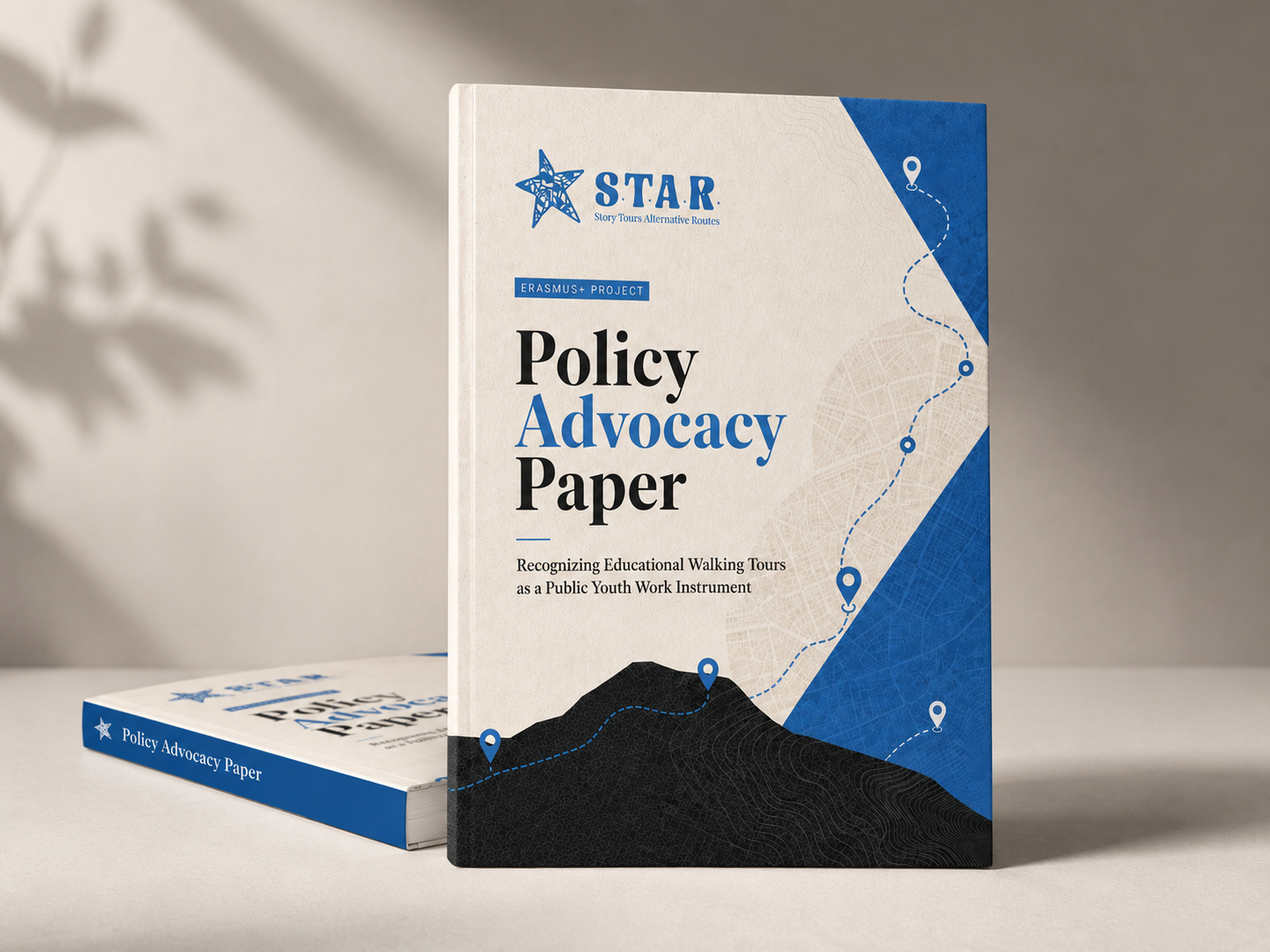
The STAR: Story Tours Alternative Routes project is pleased to present its new Policy Advocacy Paper: “Recognising Educational Walking Tours as a Public Youth Work Instrument.”
This publication brings together research findings, project experience and policy recommendations developed within the STAR partnership. It highlights the potential of Educational Walking Tours as an innovative methodology for youth work, non-formal education, social inclusion and community engagement.
Across Europe and EU-accession contexts, young people face common challenges: declining participation, skills mismatches, weakened community cohesion and limited opportunities to engage meaningfully in democratic and local development processes. At the same time, youth organisations and local communities are already developing creative practices that respond to these challenges from the ground up.
Educational Walking Tours are one of these practices.
Through walking, storytelling, digital tools and community-based learning, they transform public spaces into places of dialogue, memory, participation and social reflection. They allow young people to explore local histories, listen to marginalised narratives, strengthen transversal skills and become active contributors to their communities.
The STAR Policy Paper argues that Educational Walking Tours should not be seen only as isolated project activities or tourism products. Instead, they should be formally recognised as a non-formal youth work instrument operating at the intersection of education, culture, inclusion and local development.
Based on multi-country research involving youth surveys, organisational interviews and focus groups, the paper shows that Educational Walking Tours can generate strong educational, civic and social outcomes. Participants reported increased confidence, stronger digital storytelling skills, deeper understanding of social inclusion and greater motivation to engage with local issues.
However, the research also identifies a clear policy gap: despite their impact, Educational Walking Tours often remain outside formal youth, education and cultural policy frameworks. This limits their sustainability, quality assurance and long-term potential.
For this reason, the Policy Paper calls on ministries, municipalities, EU institutions, donors and youth organisations to support the formal recognition, sustainable financing and integration of Educational Walking Tours into public policy strategies.
The document presents a strategic framework based on four key areas: formal recognition and quality standards, sustainable financing mechanisms, cross-sector cooperation, and community empowerment through youth leadership.
By recognising Educational Walking Tours as a public youth work instrument, institutions can support an existing practice that already creates public value: empowering young people, activating communities, preserving local heritage, fostering inclusion and strengthening civic participation.
The full STAR Policy Advocacy Paper is available in PDF and can be downloaded below.
Download the PDF: Policy Advocacy Paper Digital
This practical resource was developed within the Erasmus+ KA220 Cooperation Partnership project S.T.A.R: Story Tours Alternative Routes, co-funded by the European Union with the support of the Italian Youth Agency.